
Shipping is not the same as progress.
A team can deliver every roadmap item, meet every deadline, and still create very little value. The dashboards remain green, the release train keeps moving, and yet customers do not make meaningful progress. Costs increase. Complexity grows. The organisation becomes more committed to a solution while becoming less certain that it is solving the right problem.
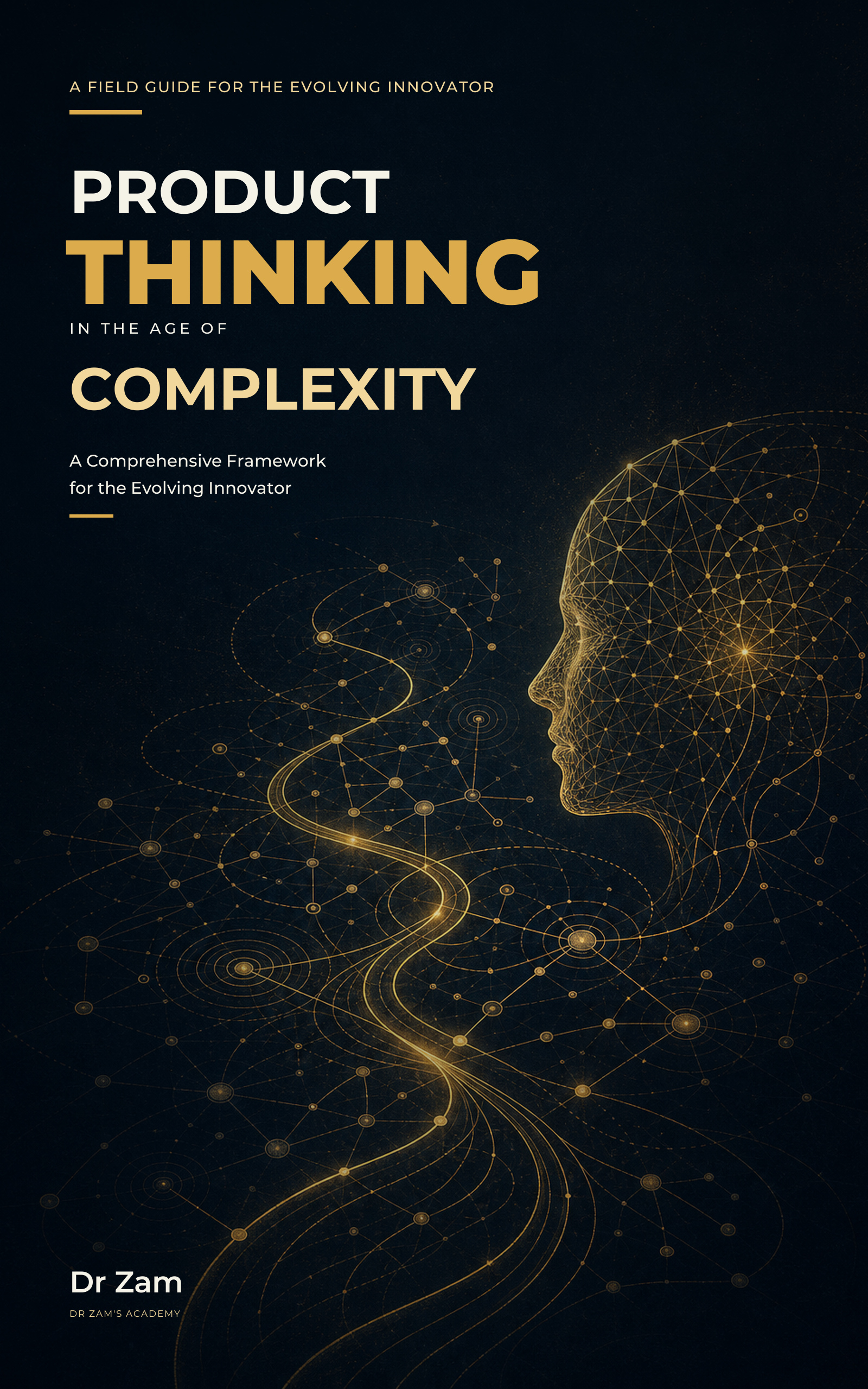
This tension is why I wrote Product Thinking in the Age of Complexity: A Comprehensive Framework for the Evolving Innovator.
The book is for product managers, founders, designers, engineers, executives, service leaders, educators, and public-sector teams who must make consequential decisions before certainty is available. It provides a practical way to choose what deserves to be built, test the assumptions that could make an investment fail, and adapt before large commitments become expensive mistakes.
Why Product Thinking Must Change
Traditional product practices often assume that problems can be isolated, plans can be stabilised, and delivery can be separated from discovery. That assumption becomes fragile when customers adapt, incentives collide, regulations change, platforms interact, and artificial intelligence expands both possibility and risk.
In these conditions, a product is not merely an interface, service, course, device, or platform. It is a value system: a changing relationship among people, organisational choices, technology, incentives, operating constraints, and wider consequences.
Product thinking therefore has to extend beyond feature prioritisation. It must connect customer progress with business value, feasibility, usability, responsibility, strategy, and system health.
The EVOLVE Framework
At the centre of the book is the EVOLVE Framework, a six-part discipline for making better product bets under uncertainty.
Examine the system
Look beyond the visible screen or workflow. Map the actors, incentives, feedback loops, hidden work, power relationships, dependencies, and plausible unintended consequences.
Verify the value
Understand the progress people are genuinely trying to make. Seek evidence stronger than stated preference, and distinguish a real problem from a strategically worthwhile problem.
Orient around outcomes
Connect human progress, observable product behaviour, organisational results, guardrails, and system health. A useful outcome tells a team what should improve and what must not be damaged in the process.
Learn through small bets
Test the weakest consequential assumption before expanding investment and exposure. The purpose of an experiment is not to decorate a decision with data; it is to create evidence capable of changing the decision.
Validate the whole proposition
Examine value, usability, feasibility, viability, responsibility, and strategic coherence together. A product can succeed on one dimension and still fail as a whole.
Evolve the product system
Use real-world evidence to adapt not only the product, but also the operating model, team boundaries, governance, portfolio choices, and leadership habits around it.
From Feature Factory to Learning System
The alternative to a feature factory is not slower delivery or endless research. It is a learning system in which commitments are proportional to evidence.
That means framing problems before funding solutions, making assumptions visible, designing tests around consequential uncertainty, and treating roadmaps as portfolios of choices rather than promises of output. It also means deciding in advance what evidence would justify continuing, changing, pausing, or stopping.
This discipline becomes especially important for AI-enabled products. A human in the loop is not automatically a safeguard. Automation can remove routine cases while concentrating rarer and more difficult exceptions in the hands of already stretched people. Responsible product leadership requires evidence about the whole operating system—not only model performance in isolation.
What Is Inside the Book
Alongside the EVOLVE Framework, the book includes decision tools, three detailed composite cases, responsible AI guidance, and a reusable field guide. It concludes with a thirty-day product-thinking reset that teams can apply to a live product area without waiting for a large transformation programme.
My aim is practical: to help teams build less theatre, make better bets, and create value that survives contact with reality.
Product Thinking in the Age of Complexity is available in Kindle and paperback editions on Amazon.
If you work in product, innovation, digital transformation, education, service design, or responsible AI, I would be glad to hear which part of the EVOLVE Framework speaks most directly to the decisions you face.
— Dr Zam

